
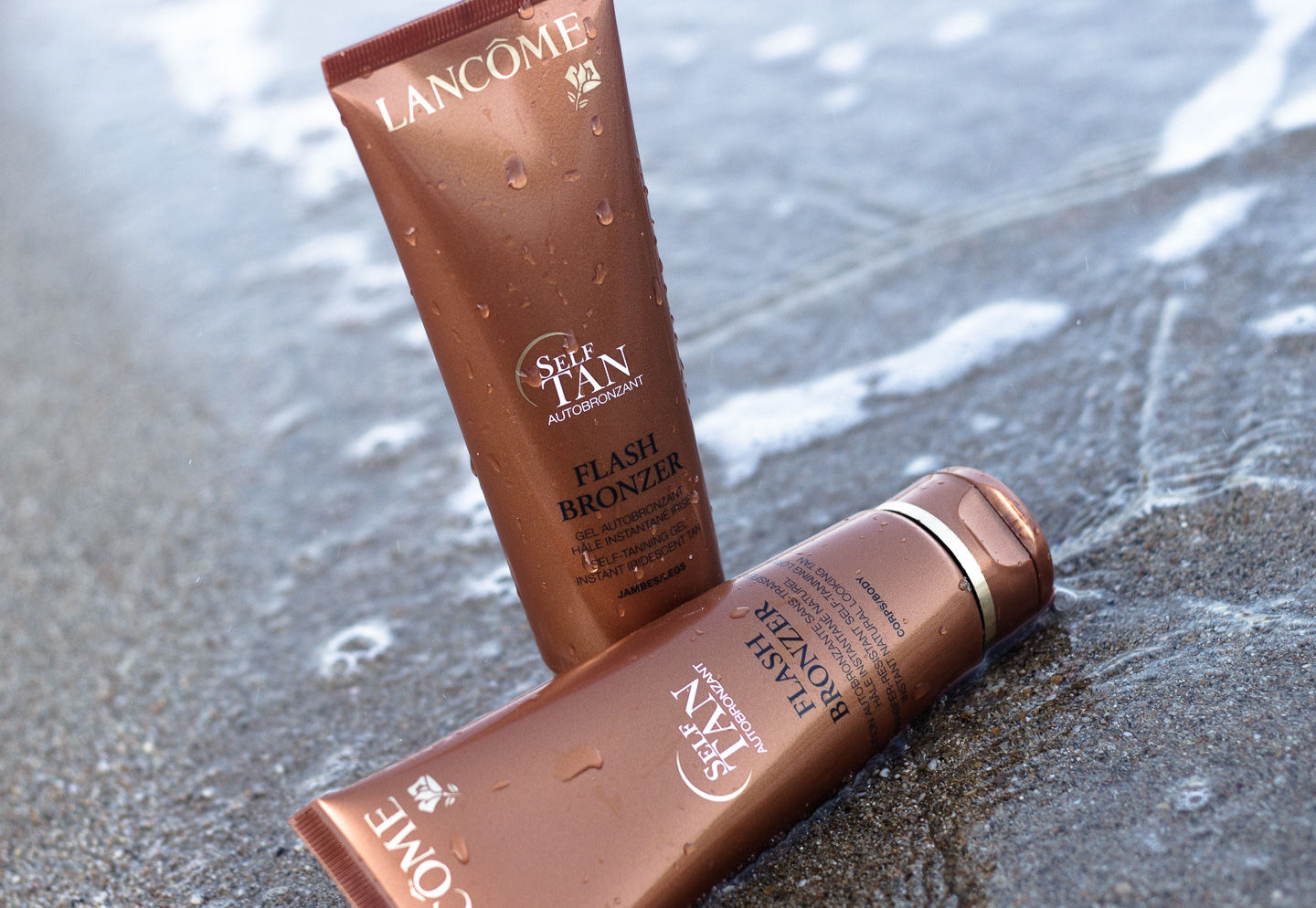
You’ve tried three self-tanners in the past year. One left orange streaks across your knees. One smelled like biscuits for two days straight. And one developed so unevenly it looked like a relief map of a country that doesn’t exist. Now you’re eyeing Lancôme Flash Bronzer and wondering if the premium price tag buys anything real — or if you’re about to repeat the same mistake.
Here’s the straight answer.
Why Self-Tanners Go Wrong (And It’s Usually Not the Formula)
Most self-tanner disasters aren’t formula failures. They’re technique failures. Understanding why changes how you shop — and what you actually do with whatever you buy.
The active ingredient in virtually every self-tanner is DHA (dihydroxyacetone) — a sugar-derived compound that reacts with amino acids in the outermost layer of your skin to produce brown color. This isn’t stain or dye; it’s a chemical reaction. And that reaction takes 4–8 hours to complete. That delay is where most people go wrong: they apply, see nothing happening, panic, apply more, and end up with overlapping layers that develop unevenly into something resembling a toasted disaster.
Why Dry Skin Creates Streaks
Dead skin cells absorb DHA faster than living ones. Your elbows, knees, ankles, and knuckles — anywhere with naturally thicker, drier skin — grab DHA aggressively and develop darker than surrounding areas. Skip exfoliation before application and those patches turn noticeably, obviously darker than the rest of your body. This single mistake accounts for the majority of bad self-tanner experiences people blame on the product. It’s completely preventable with a decent body scrub used 24 hours before you apply anything.
Why pH Affects Development
DHA reacts more efficiently at a slightly acidic pH. Some moisturizers and body washes are alkaline enough to interfere with that reaction, slowing development and causing patchiness. Applying a thick alkaline cream immediately before a self-tanner is a reliable way to get uneven color. AHA exfoliants — glycolic acid, lactic acid — actually help even out DHA development when used correctly. The rule: use them 24+ hours before tanning, not right before, or you’ll disrupt the reaction completely.
The Guide Color Confusion
Many self-tanners include a cosmetic tint so you can see where you’ve applied product and avoid gaps. That tint washes off in the shower. The actual DHA tan stays. People who don’t know this shower too soon, see color rinsing away, assume the product failed — and immediately post a one-star review. The developing tan was still working the whole time. Knowing this distinction alone saves a significant amount of money and frustration.
What DHA Actually Does to Your Skin Over 24 Hours
DHA doesn’t penetrate living skin. It reacts only with the stratum corneum — the outermost dead skin layer. This means every DHA self-tan is temporary. Your skin continuously sheds that layer, and the tan fades with it over 5–7 days. No self-tanning product produces a permanent result. Any product claiming otherwise is either misleading or marketing “gradual daily use” in a confusing way.
The development timeline: guide color appears immediately if the formula has one. Real DHA color begins around 3–4 hours. Full development happens at 8 hours. Peak color depth shows at 24 hours. After that, fading begins as skin cells turn over naturally.
Temperature affects how quickly the reaction completes. Applying in a warm bathroom and then spending hours in a cold dry room slows the reaction. Hot showers in the first 6 hours can interrupt the DHA process before it finishes — you get reduced color depth as a direct result. Not a product flaw. A chemistry fact.
DHA provides zero UV protection. The brown color is purely cosmetic. You need SPF regardless of how tan your self-tanner makes you look. The melanin triggered by actual sun exposure and the color produced by DHA are completely different biological processes. One provides some protection. One doesn’t.
Skin microbiome also plays a role most brands don’t discuss. Certain skin bacteria interact with DHA, influencing how the reaction proceeds and contributing to the distinctive smell that develops hours after application. This is why the same product can smell noticeably different on two people with different microbial environments.
Lancôme Flash Bronzer: What It Is and What the Formula Actually Does
Lancôme Flash Bronzer is a self-tanning line with separate face and body formulas. The face version is a light gel; the body formulas include lotion and oil options. The “Flash” name refers to the dual-action design: instant visible bronze from an included tint, plus a developing DHA tan over the hours that follow.
That instant-plus-developing approach solves one specific real problem: you can see exactly where you’ve applied product, which dramatically reduces streaks and missed patches. It won’t fix poor technique or skipped prep — nothing will — but it eliminates a significant variable. Guessing coverage is gone.
| Feature | Flash Bronzer Face Gel | Flash Bronzer Body Lotion |
|---|---|---|
| Texture | Light gel, fast-absorbing | Creamy lotion |
| Instant guide tint | Yes — light bronze | Yes — deeper bronze |
| DHA development time | 4–8 hours | 4–8 hours |
| Key added ingredient | Vitamin E | Vitamin E |
| Typical retail price | ~$45–55 | ~$40–50 |
| Best for skin tone | Fair to medium | Medium to tan |
| Finish | Matte-natural | Slightly luminous |
The Vitamin E addition is functional, not cosmetic marketing. Vitamin E is a fat-soluble antioxidant that protects the skin’s surface while DHA processes — the reaction generates minor oxidative byproducts, and Vitamin E helps neutralize those. It also contributes to the non-drying finish that sets Flash Bronzer apart from basic DHA-only formulas, which can leave skin feeling tight and parched after the tan develops.
Does the Instant Bronze Look Natural?
Immediately after application: yes, it reads as a sheer wash of color. Believable enough that you could go out without waiting for full development. On fair skin with pink undertones, the tint can lean slightly warm-orange in the first hour before DHA development deepens and shifts the tone toward golden-brown. On medium skin tones, the tint sits naturally from the start. Don’t judge the final result on what you see in the first 60 minutes. That’s like judging a soufflé two minutes into baking.
How Long the Tan Lasts
With proper prep and one application, expect 5–6 days of visible color before fading becomes obvious. Daily moisturizing extends longevity — a layer of body lotion each morning slows the skin cell turnover that causes fading. Skip moisturizer and expect patchy fading starting day 4. The face formula fades slightly faster than the body lotion because facial skin has a quicker cell turnover rate.
Skin Types That Won’t Get On With Flash Bronzer
Very oily skin breaks down the face gel faster — if your T-zone is producing enough sebum to make your phone screen greasy by midday, expect uneven fading within 2–3 days rather than 5–6. Reactive skin prone to eczema or rosacea should also approach cautiously, not because of DHA specifically, but because the tint additives in dual-action formulas occasionally trigger sensitivity that plain DHA formulas don’t.
Flash Bronzer vs. St. Tropez, Tan-Luxe, and Bondi Sands
Lancôme is not the only premium option on this shelf. Here is how Flash Bronzer actually compares to the products competing for the same money and skin.
St. Tropez Self Tan Classic Bronzing Mousse ($34) is the category benchmark. It sets the color tone that most people picture when they imagine a good self-tan — warm, golden, not orange. For very fair skin, St. Tropez edges Flash Bronzer on undertone accuracy. Flash Bronzer edges St. Tropez on skin feel — the mousse format can be drying on mature or already-dry skin. If hydration matters, Flash Bronzer wins. If pure color tone on fair skin is the priority, St. Tropez is the safer call.
Tan-Luxe The Gradual ($42) uses a serum format with a lower DHA concentration. It’s ideal for first-time self-tanners who want subtle, buildable color without committing to a full application in one go. The tradeoff is real: you’ll need 4–5 days of consistent use to match the depth Flash Bronzer delivers in a single session. If you want a light glow you control day by day, Tan-Luxe is the better pick. If you want results in one application, it isn’t.
Bondi Sands Everyday Gradual Tanning Milk ($18) is the budget option that actually delivers. It works. The color tone skews more bronze-orange than the warm golden development from Lancôme. On medium to tan skin tones, the difference is minor and most people won’t care. On fair skin with cool or neutral undertones, the Bondi Sands orange cast is noticeable enough to matter. At less than half the price, it’s worth testing first — just go in knowing the color payoff is different.
Charlotte Tilbury Airbrush Flawless Bronzer ($54) is a different product category entirely — it’s a pressed powder bronzer for makeup, not a self-tanner. You apply it on top of skin, not into it, and it washes off the same night. If you want something for a single event rather than a developing tan, that’s the right direction. But it doesn’t do what Flash Bronzer does, and they shouldn’t be compared as if they do.
The verdict: for face self-tanning on normal-to-dry skin, Flash Bronzer is the strongest option at the premium tier. St. Tropez wins for body on a tighter budget. Tan-Luxe wins for complete beginners. Bondi Sands wins on value. Flash Bronzer wins when hydration, a dual face-and-body formula, and a non-drying finish are the actual priorities.
Should You Actually Buy Lancôme Flash Bronzer?
Yes — if you have normal to dry skin, want face and body coverage from one product line, and are willing to pay for a self-tanner that doesn’t leave your skin feeling stripped after development. The Vitamin E base makes a real difference in finish quality compared to budget alternatives. The instant guide tint genuinely reduces application errors. The color development lands in a natural golden-brown range that works on fair to medium skin without the orange shift that cheaper DHA formulas are prone to.
Don’t expect miracles. Flash Bronzer follows every rule that every DHA self-tanner follows. Exfoliate 24 hours before. Apply to dry skin. Use circular motions on high-absorption zones like elbows and knees. Wait at least 6 hours before showering. Moisturize daily. Skip any of those steps and no formula — at $18 or $55 — saves the result.
For oily skin, particularly on the face: save the money and try St. Tropez Self Tan Express Bronzing Mousse, which holds more consistently on sebaceous skin. For everyone else, Flash Bronzer earns its price point without requiring an apology for it.
Self-tanning formulas have been relatively flat for years — everyone is iterating on the same DHA foundation. The innovation that’s actually coming involves encapsulated DHA delivery, microbiome-adaptive formulas, and pH-responsive systems that interact more intelligently with individual skin chemistry. When those hit the mainstream market, the gap between products like this will get far more interesting to debate.