
After 50, skin loses collagen at roughly 2% per year — double the rate of your 40s. By the time you reach 60, you’ve lost close to 20% of the structural scaffold that gives skin its density and resilience. That’s not a gradual drift; it’s a measurable biological cliff. And it’s why the moisturizer that worked brilliantly in your 40s suddenly feels like it’s doing almost nothing.
This is the context that makes the Clarins Everlasting Youth Fluid worth understanding properly — not as an expensive moisturizer, but as a targeted product built for a specific biological problem. Before we get to the product, look at what’s actually happening in your skin. That biology determines everything about what you should be buying.
Why Your Skin Changes So Dramatically After 50 — The Biology Behind It
Most anti-aging content skips this and jumps straight to product recommendations. That’s a mistake, because understanding the mechanism tells you exactly what kind of product you need — and which promises are marketing fluff versus real formulation science.
What Estrogen Was Doing for Your Skin All Along
Estrogen receptors exist in fibroblasts, keratinocytes, and melanocytes — the skin cells responsible for building collagen, forming the outer barrier, and regulating pigmentation. Estrogen was quietly managing all of them.
When estrogen drops sharply during and after menopause, fibroblasts slow significantly. Collagen synthesis falls. Elastin production weakens. The extracellular matrix — the connective tissue that gives skin its volume and firmness — breaks down faster than it can be rebuilt. In the first five years after menopause, skin loses up to 30% of its collagen. That’s not a gradual shift. It’s structural collapse happening in slow motion, visible in sagging jawlines, hollowed temples, and that crepey surface texture that doesn’t respond to ordinary hydration.
Why Hydration Alone Won’t Reverse This
Dehydration is a symptom. Collagen loss is the cause. You can apply hyaluronic acid serum twice a day and still not address the structural thinning happening in the dermis. Hyaluronic acid holds water in the skin matrix — but when the matrix itself has lost density, there’s less framework to hold anything in place. The result: brief plumpness after moisturizer, then rapid reversion to looking flat and crepey.
What mature skin actually needs are ingredients that work at the level of the dermis. Things that signal fibroblasts to produce more collagen (peptides, retinol), protect existing collagen from enzymatic breakdown (antioxidants — particularly vitamin C and ferulic acid), or support the skin’s renewal cycle. That cycle slows from a 28-day turnover in your 20s to 45-60 days by your 50s, which means surface treatments take longer to show results and need to work harder to get there.
This is why a category of products specifically formulated for mature skin exists as a functional distinction, not just a marketing one. The best youth fluids target the dermis, not just the epidermis. They’re not heavier moisturizers with better packaging — they’re formulas built to interact with the biological mechanisms behind structural decline. The ingredients list matters in a way it simply doesn’t for a basic daily moisturizer.
How to Layer Your Morning Skincare So Actives Actually Absorb
Product order matters more than most people realize. Apply in the wrong sequence and you’re either blocking absorption, diluting actives before they can penetrate, or wasting product on top of a layer that prevents skin contact entirely. Here’s the routine logic that works for mature skin — and where a youth fluid fits naturally:
- Start with a gentle, non-stripping cleanser. A high-pH or foaming cleanser damages the skin barrier. In mature skin, where the lipid layer is already compromised, this makes every subsequent product less effective. Use a milky or low-pH gel formula that rinses clean without leaving skin tight or squeaky.
- Apply a vitamin C or peptide serum to slightly damp skin. Vitamin C has strong clinical evidence for stimulating collagen synthesis. Peptides directly signal fibroblast activity. Both work best applied first — they need direct skin contact, and thicker products layered on top can block penetration and reduce efficacy significantly.
- Apply your anti-aging fluid over the serum while it’s still absorbing. Fluid textures layer without blocking the serum beneath or feeling heavy before SPF. Give it about 60 seconds before adding anything on top. This step is where the Clarins Everlasting Youth Fluid slots in naturally — it functions as a bridge between your active serum and your sun protection.
- Finish with SPF 30 or higher. Every single day. UV exposure is the single largest external driver of collagen breakdown. Every active ingredient in your routine loses ground daily if you skip this step. SPF is part of the anti-aging strategy — not an optional add-on.
At night, the routine changes purpose entirely. Morning is about protection and maintenance — getting actives absorbed and shielding that work with sun protection. Night is about repair and stimulation, when skin’s cellular recovery cycles are most active and UV isn’t degrading your ingredients. Swap the youth fluid for a richer cream, a retinol product, or both. Retinol has the strongest clinical evidence of any topical for accelerating cell turnover and stimulating collagen synthesis — and it belongs exclusively in evening routines because UV exposure both degrades the molecule and increases photosensitivity.
One rule that applies at every stage: don’t apply an anti-aging fluid on top of a facial oil. Oils are occlusive — the fluid will sit on the surface rather than penetrate. Apply the fluid first, let it absorb, then layer oil on top if you need that occlusion.
Clarins Everlasting Youth Fluid — What’s Actually Inside and Whether It Works
Buy it. But know exactly what you’re buying it for, because misaligned expectations are the main reason people return good products.
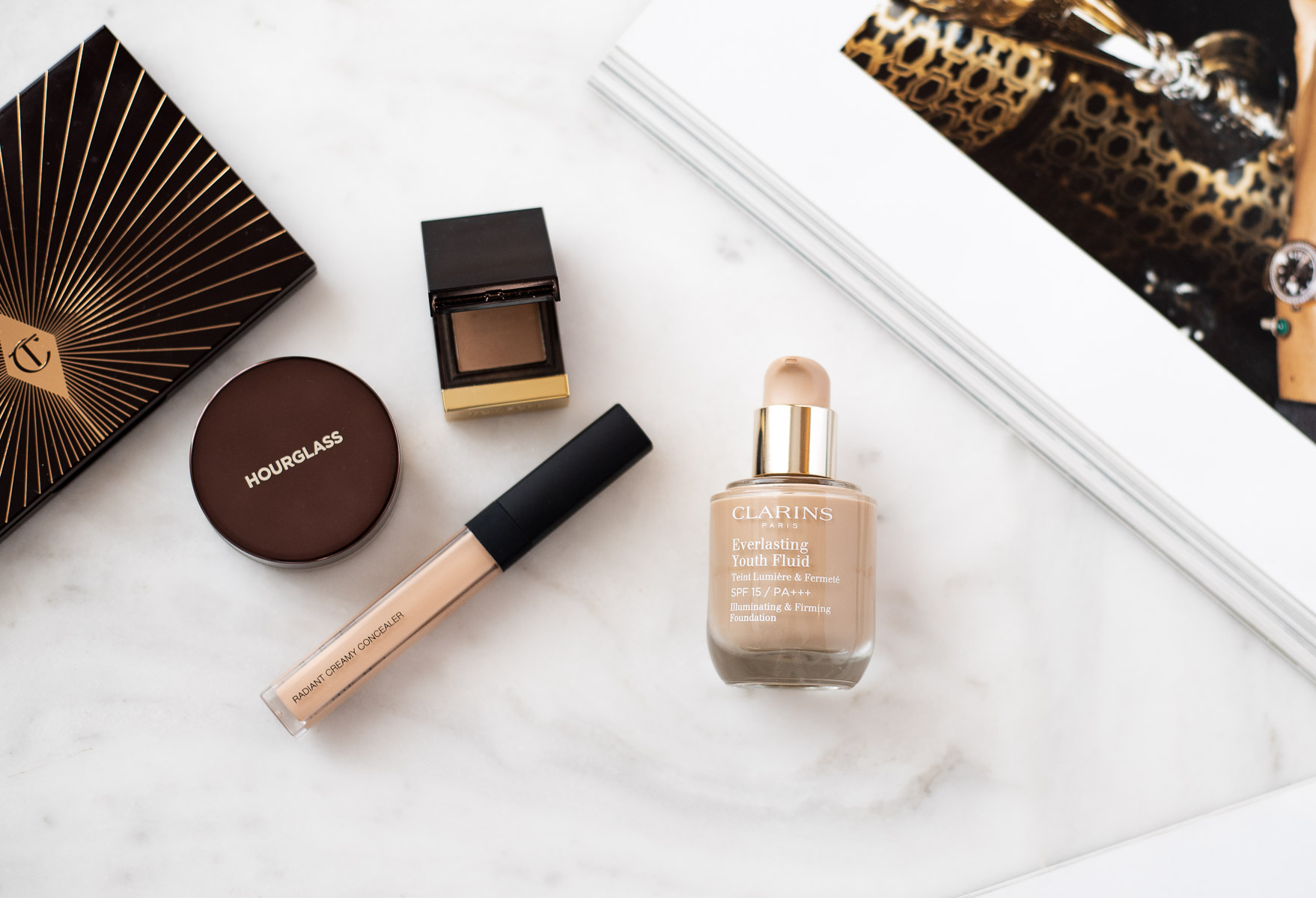
The Clarins Everlasting Youth Fluid (~$95 for 50ml) is designed for skin that has lost density, firmness, and luminosity — roughly the 50+ range, though Clarins doesn’t put a rigid age bracket on the product. The texture is the first thing to notice: genuinely fluid, absorbs without residue, and doesn’t pill under SPF or foundation. A lot of luxury anti-aging creams fail on exactly this point — they’re too rich to layer comfortably in a morning routine. The Clarins doesn’t have that problem.
Key Ingredients — What They Target and Whether the Science Holds
Harungana Extract (sourced from Madagascar) is Clarins’ hero ingredient in this formula. It targets the skin’s chronobiological cycle — the natural rhythm of cellular repair and regeneration. Clarins positions it as helping reset that rhythm, particularly supporting the overnight recovery window. Chronobiology in skincare is a legitimate research area; published data shows skin repair peaks between 11pm and 4am, meaning formulas that work with this cycle rather than against it do have a functional rationale.
White Tea Extract is a potent antioxidant. Free radical damage accelerates collagen breakdown — it’s one of the core mechanisms behind photodamage and environmental aging. White tea provides meaningful antioxidant coverage alongside, though not replacing, a dedicated vitamin C serum in your routine.
Katafray Bark Extract is proprietary to Clarins formulas. They position it as a firming active targeting skin elasticity. Independent peer-reviewed data on Katafray specifically is limited, but this extract has appeared across multiple Clarins formula generations with consistent consumer-reported results — their internal efficacy testing is extensive, even if not publicly published.
The formula also includes SPF 15 — genuinely useful as a supplemental layer on low-exposure days, but not sufficient as your only sun protection.
Who Should Buy This — and Who Should Skip It
Best fit: normal to combination skin in its 50s or 60s that has started losing firmness and radiance. The fluid texture is comfortable enough for year-round morning use and sits well under makeup without occluding pores.
Skip it if your skin is severely dry or dehydrated after cleansing. The formula won’t deliver enough lipid-based nourishment to feel satisfying as a standalone. In that case, the Clarins Multi-Active Night Cream (~$75) or a richer formula is the better entry point. Add the fluid as a morning layer once your barrier is stable and functioning.
Realistic expectations with 8 weeks of consistent daily use: improved surface radiance, smoother texture, skin that feels denser and more resilient under pressure. No topical product reverses deep structural collagen loss — that requires clinical-grade interventions. But within what a quality moisturizer can realistically deliver, this one performs at the top of its class.
How the Clarins Youth Fluid Compares to Alternatives at This Price Point
| Product | Price (50ml) | Key Actives | Texture | SPF | Best Skin Type |
|---|---|---|---|---|---|
| Clarins Everlasting Youth Fluid | ~$95 | Harungana, White Tea, Katafray Bark | Lightweight fluid | SPF 15 | Normal to combination, 50+ |
| Estée Lauder Revitalizing Supreme+ Moisturizer | ~$90 | ChronoluxCB Technology, peptides, ferment extract | Rich cream | None | Normal to dry, 45+ |
| Lancôme Rénergie H.C.F. Triple Serum | ~$115 | Hyaluronic acid, niacinamide, ferulic acid | Serum-fluid | None | All types — serum step only |
| Darphin Stimulskin Plus Absolute Renewal Cream | ~$195 | Botanical stem cells, peptides, essential oils | Rich cream | None | Dry to very dry, mature skin |
| La Mer The Moisturizing Fluid | ~$360 (60ml) | Miracle Broth — fermented sea kelp | Lightweight fluid | None | All types, no budget ceiling |
The Clarins competes most directly with the Estée Lauder Revitalizing Supreme+. At nearly the same price, the Estée Lauder has stronger synthetic actives (peptides, ferment extracts) and suits drier skin better. The Clarins wins on texture — it layers more comfortably under makeup and SPF — and the built-in SPF 15 adds a practical buffer for morning use. For combination skin in its 50s, the Clarins is the cleaner pick.
The Lancôme Rénergie H.C.F. isn’t a direct competitor — it’s a serum, not a moisturizer. Comparing them is conflating two different routine steps. If your serum slot is already occupied by vitamin C, the Lancôme adds redundancy, not value. The Darphin Stimulskin Plus and La Mer Moisturizing Fluid serve a different buyer: severely dry mature skin with no budget ceiling. At three to four times the price, neither outperforms the Clarins meaningfully for normal to combination skin in the 50+ category.
Five Mistakes That Make Anti-Aging Fluids Underperform
These are common enough to be worth naming directly. Any one of them will blunt the results you’d otherwise get from a well-formulated product.
- Treating SPF 15 as your only sun protection. The Clarins includes it — SPF 15 blocks roughly 93% of UVB rays. But SPF 30 blocks 97%, and that gap compounds over years of daily exposure. Layer a dedicated SPF 30+ on top, especially for outdoor days or driving. The Clarins SPF is a backup, not a substitute.
- Applying the fluid on top of a facial oil. Oils are occlusive. If you’ve applied one first, the fluid sits on the surface instead of penetrating — and you’ve just paid $95 for a fancy sealant. Apply the fluid to clean skin (or directly over a thin serum), let it absorb fully, then add any oil on top.
- Quitting at four weeks and calling it a failure. Skin cell turnover in mature skin takes 45-60 days. Most meaningful structural improvement from anti-aging formulas happens between weeks 6 and 12. Abandoning a product at the one-month mark — before a single full turnover cycle has completed — is one of the most common and most expensive mistakes in skincare.
- Using it without a vitamin C serum underneath. The Clarins handles antioxidant defense and firming. It doesn’t replace the collagen-synthesis stimulation that vitamin C delivers. These aren’t competing products; they work different parts of the same problem. Pairing the Clarins fluid with a vitamin C serum gets you further than either product alone.
- Buying it for severely dry or dehydrated skin. A fluid texture doesn’t carry enough lipid content to satisfy very dry skin. If your skin is tight or flaky after cleansing, start with a richer formula and re-evaluate once your barrier is stable. The fluid works best when your skin’s baseline moisture needs are already being met.
The science behind skin aging is advancing quickly — chronobiology, microbiome research, and next-generation peptide sequences are moving from lab research into mainstream formulations faster than they were even three years ago. What the Clarins Everlasting Youth Fluid represents today — botanical-driven, texture-intelligent, built for the specific biology of post-menopausal skin — is the current benchmark in its category. Within a few years, those benchmarks will shift again. The underlying biology won’t change, but the tools available to address it will keep getting more precise.