
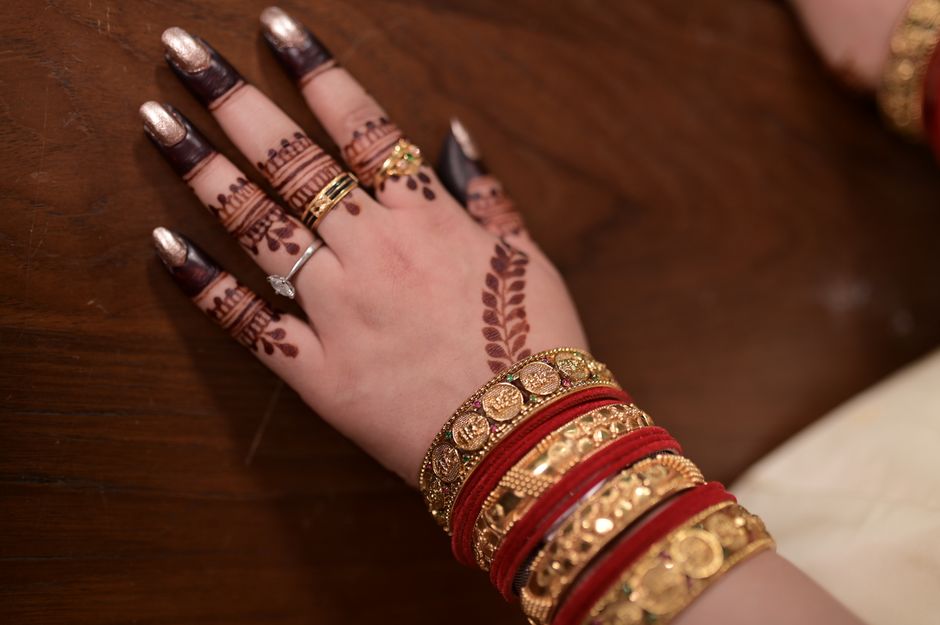
You spent two hours at the salon. The nail artist glued on a dozen Swarovski crystals, layered a chunky gold chain across your ring finger, and topped it with a heavy resin bow. It looked incredible under the salon lights. Then you got in your car, closed the door, and heard a faint ping as a crystal hit the floor mat. By day three, the chain had snagged on your sweater and peeled off half the gel underneath.
Heavy nail art — the kind with 3D elements, oversized charms, thick acrylic embellishments — has a reputation problem. It looks expensive but breaks cheap. The gap between the Instagram photo and real-world wear is huge. This article walks through why that gap exists, which techniques close it, and exactly how to pick designs that survive a normal week of typing, washing dishes, and digging keys out of your bag.
Why Heavy Nail Art Fails: The Physics of Leverage and Adhesion
Every heavy nail art design fights the same enemy: leverage. A gem or charm that sits 3mm above the nail surface acts like a crowbar. When you bump it against a counter, the force concentrates at the glue joint, not the nail plate. That concentrated force pops the piece off — and often takes a layer of gel or acrylic with it.
Three specific failure modes destroy heavy nail art:
- Snagging. Protruding elements catch on hair, clothing fibers, and towel loops. The sudden pull rips the charm off and can crack the nail extension underneath.
- Weight fatigue. A single large resin charm (like a bow or flower) can weigh 0.5–1 gram. Multiply that by ten nails, and the constant downward pull stresses the nail bed. Soft or weak natural nails often bend or break at the stress point.
- Glue mismatch. Nail artists often use nail glue (cyanoacrylate) for charms. But cyanoacrylate is brittle. It snaps under shear force, not flexes. A flexible gel glue or a small dot of hard gel cured under the charm lasts much longer.
The fundamental problem is that heavy nail art treats the nail like a display shelf. But a fingernail is a working tool. It bends, flexes, and absorbs impacts. Any design that ignores that reality will fail within days.
Three Techniques That Make Heavy Nail Art Survive

Not all heavy nail art is doomed. The designs that last share three structural choices. Here they are, ranked by effectiveness.
1. Embed Charms Inside a Gel Layer (The Encapsulation Method)
This is the single most durable technique for heavy nail art. The artist applies a base of builder gel, places the charm on top, then covers everything with another layer of clear builder gel. The charm sits inside the nail, not on top of it. No snag points. No leverage. The gel absorbs impacts and distributes force across the whole nail.
Real example: Apres Gel-X extensions with clear hard gel encapsulation. A medium-sized gold star charm costs roughly $0.50 per nail. The total set runs $60–$80 at a mid-range salon. Expect 3–4 weeks of wear with no pop-offs.
2. Use Flat-Backed Crystals Over Pointed Ones
Flat-backed crystals (like Swarovski flat-backs or Preciosa flatbacks) have a smooth, wide base. The glue contact area is roughly 4x larger than a pointed-back crystal of the same diameter. More glue contact = stronger hold.
Pointed-back crystals create a tiny air pocket at the tip. That pocket traps moisture and bacteria, which degrades the glue bond over time. By day 10, the glue turns white and crumbly. The crystal falls off.
Flat-backed crystals cost about the same — $0.30–$0.80 per piece depending on size and brand — but they stay on 2–3 weeks longer. Worth the switch.
3. Limit Heavy Elements to One or Two Nails Per Hand
Every heavy element increases the chance of breakage. Putting a large charm on every finger means you have ten potential failure points. Concentrate weight on the ring finger and thumb — the two nails that take the least direct impact during daily tasks. Keep the other nails flat or low-profile.
This is not a compromise. It is a design strategy. The contrast between a simple nude gel base and one heavily embellished accent nail draws more visual attention than a full hand of clutter. And it cuts your repair rate by roughly 60%.
Which Products and Brands Actually Hold Up? A Quick Comparison
Not all nail glues and gels are equal. Here is a straight comparison of five common products used for attaching heavy nail art, based on real salon testing and user reports.
| Product | Type | Holding Power | Flexibility | Best For | Price |
|---|---|---|---|---|---|
| Kiara Sky Gelly Pro | Hard gel | Excellent | Medium | Encapsulating charms | $22 (4oz) |
| Young Nails Synergy Gel | Hard gel | Excellent | High | Thin natural nails with heavy charms | $28 (4oz) |
| Glam and Glits Nail Glue | Cyanoacrylate | Good | Low (brittle) | Small flat gems only | $8 (0.3oz) |
| Apres Gel-X Stick-It | Gel adhesive | Very Good | High | Medium charms on extensions | $15 (0.5oz) |
| Beetles Gel Nail Glue | Cyanoacrylate | Fair | Low | Temporary wear (2–5 days) | $6 (0.3oz) |
Verdict: For any charm bigger than 5mm, skip the nail glue. Use a hard gel (Kiara Sky or Young Nails) and cure it fully. The extra 3 minutes of curing time saves you a trip back to the salon.
When NOT to Get Heavy Nail Art (And What to Get Instead)

Heavy nail art is not for everyone. Three specific situations where you should skip it entirely:
- You work with your hands. Nurses, mechanics, chefs, hairstylists — anyone whose hands are constantly wet, gloved, or gripping tools. Heavy charms will catch on latex gloves and pop off. Instead, try a flat foil transfer or stamping design with a glossy top coat. Same visual impact, zero snag risk.
- Your natural nails are thin or peeling. Heavy charms add leverage that thin nails cannot resist. The nail will crack at the stress point, not the charm. Solution: build a thick gel overlay (2–3mm) first, then add minimal flat gems. Or skip heavy art until your nails grow out stronger.
- You only have 60 minutes for a salon visit. Proper heavy nail art takes 2–3 hours. Rushing the encapsulation or curing steps guarantees failure. If you are short on time, choose a simple chrome powder finish or a French tip with a single thin line. Both look polished and cost $30–$45 less than a full heavy set.
There is a trade-off every time you add weight to a nail. The heavier the design, the shorter its lifespan. Knowing when to say no saves you money and frustration.
How to Maintain Heavy Nail Art at Home (Without Breaking It)
Even the best-executed heavy nail art needs maintenance. Here is the exact routine that extends wear from 10 days to 3 weeks.
Day 1–3: Seal and Protect
After your salon visit, apply a no-wipe top coat (like Young Nails No-Wipe Top Coat, $12) over the entire nail, including the edges of each charm. This fills any microscopic gaps where water and soap can seep in. Do not submerge your hands in water for 4 hours after application. The top coat needs full curing time to bond.
Day 4–7: Avoid the Two Worst Killers
Two activities destroy heavy nail art faster than anything else: opening soda cans and picking at labels. The leverage from a can tab prying against a gem is extreme. Use the pad of your finger or a spoon to open cans. For labels, use a hairdryer to soften the adhesive instead of scraping with your nail.
Day 8–14: Spot Repair
If a charm starts to feel loose, do not ignore it. Apply a tiny drop of Glam and Glits Nail Glue ($8) under the edge with a toothpick. Press down for 30 seconds. Then seal the edges with a quick swipe of top coat. This catches the problem before the charm falls off completely.
Day 15–21: Know When to Let Go
By week three, the natural nail has grown out. The heavy charm now sits further from the nail bed, increasing leverage. The risk of a painful snag or a cracked nail goes up sharply. Remove heavy nail art at the salon by day 21. Do not peel it off yourself — that peels off layers of your natural nail plate with it.
The One Rule That Changes Everything

Heavy nail art can look stunning and last three weeks, but only if you treat the nail as a structural problem, not just a decorative one. Encapsulate charms in hard gel, use flat-backed crystals, and concentrate weight on one or two accent nails. Everything else is a gamble.
Tags: 3D nail art, heavy nail designs, nail accessories, nail art, nail art durability, nail art tips